Agent Teams Workflow Design and Context Engineering: Build Agents with Claude
Mike Wheeler
Agent Sense Creator | O'Reilly Author

MIT cracked context rot with Recursive Language Models. Build a no-code RLM.
MIT recently published research on Recursive Language Models (RLMs) that reframes how AI handles massive context. Instead of cramming information into the model where it degrades, RLMs treat context as an external environment accessed on demand.
The result: processing 10M+ tokens while outperforming traditional models and eliminating Context Rot.
The challenge? Building custom massive-context AI infrastructure typically requires dedicated ML engineering teams and significant investment. MIT's RLM research offers a different path: processing 10M+ tokens at roughly $1 per query, outperforming traditional approaches that cost 2 to 3x more and still fail at scale. MIT documents their approach, but turning research into practice has remained out of reach for non-coders, until Cowork emerged.
This course teaches you to build your own RLM using Claude Cowork, Anthropic's no-code autonomous AI tool. Cowork's file-based architecture makes RLM principles accessible to non-programmers, achieving ~95% parity with what MIT proposed.
The principles you learn transfer to whatever tools emerge next. Cowork has shown what is now possible. This course teaches you to build it.
What you’ll learn
Apply MIT's RLM paradigm without code. Master Agent Sense to decide what agents should handle and Context Engineering to make it work.
Apply Jobs-to-Be-Done (JTBD) thinking to identify high-leverage agent use cases and document them in an Agent Requirements Document (ARD)
Use the Agent Workflow Design Tool to map delegation patterns, human decision points, and escalation triggers for your workflows
Apply the Agent Sense framework to evaluate workflows and identify where AI adds value versus where human judgment must stay at the helm.
Learn how MIT's Recursive Language Model research treats context as an external environment, enabling 10M+ token processing without decay.
Recognize context rot patterns in your own AI workflows and apply file-based architectures to prevent information loss over time.
Compare traditional context approaches versus RLM patterns and understand the cost and accuracy tradeoffs.
Set up Claude Cowork's file-based architecture including SKILL.md files, CLAUDE.md instructions, and folder structures for your workflow.
Achieve 90-95% of RLM benefits using selective context access, file storage, and sub-agent delegation without writing code.
Learn principles that transfer to other tools as the market evolves. Cowork demonstrates what is now possible and next for non-developers.
Create Context Requirements Documents that specify what information must persist, how it should be structured, and when it gets updated.
Apply Context State Record patterns to maintain decision trails across conversations so audits can trace how conclusions were reached.
Structure context for internal agents first, then learn to adapt patterns for customer-facing workflows as you move outward and build trust.
Export Agent Requirements Documents and Context Requirements Documents in Markdown, JSON, and formats ready for agents and leadership buy-in
Build Business Requirements Documents for executive stakeholders plus UX Requirements for customer-facing and Employee Experience specs.
Defend your design decisions to skeptical leaders using frameworks and documentation that show accountability, security, and oversight.
Follow the proven adoption path: deploy back-of-house workflows where failures are recoverable before exposing agents to customers.
Design escalation and failure handling that maintains human oversight while building organizational confidence in agent-assisted workflows
Learn how to iterate on internal workflows, measure outcomes, and expand agent capabilities as trust, competence and productivity grow.
Learn directly from Mike

Mike Wheeler
Trained 500K+ students. Teaching Agent Workflow Design & Context Engineering


Who this course is for
Operations and transformation leaders who need to introduce AI agents with accountability but lack technical staff to build from scratch.
Senior ICs and team leads who see AI potential in their workflows but need a framework to decide what to automate versus keep human.
Consultants and advisors guiding AI adoption who need tool-agnostic frameworks and documentation they can defend to skeptical clients.
Prerequisites
Experience owning or influencing reaI workflows
You should be familiar with how work is done today and have visibility into the decisions, handoffs, and outcomes involved.
Comfort making decisions with accountability
This course assumes you are used to making or advising on decisions that affect outcomes, risk, or other people’s work.
Interest in thoughtfully adapting work for AI agents
You do not need prior AI or agent experience, but you should want to thoughtfully adapt existing workflows for agent support.
What's included
Live sessions
Learn directly from Mike Wheeler in a real-time, interactive format.
Live agent workflow design studios
Interactive live sessions where we design real workflows together. We analyze tradeoffs, surface design tensions, and make defensible decisions for work you own or influence.
Agent Sense Framework
A durable decision framework for determining what agents should automate, augment, or escalate to humans. Designed to remain useful as tools, vendors, and platforms change.
Asynchronous Cowork video training modules
Self-paced video training modules covering Claude Cowork's file-based architecture and RLM principles. Get hands-on if you have Cowork access, or learn the transferable principles that apply to any platform.
Agent Design Blueprint Tool
Create your stakeholder-ready workflow blueprint during the course. Continued tool updates available when you take advantage of your free retake as an inaugural member.
Requirements Documents Template Bundle for Agents
Export-ready and customizable templates including Agent Requirements Documents, Context Requirements Documents, Business Requirements Documents, plus UX and Employee Experience specs for agents.
Capstone: From blueprint to working agent
Design a complete workflow blueprint, then build a proof-of-concept agent in Cowork applying RLM principles to overcome context limits. Walk away with stakeholder-ready documentation and a minimal viable agent demonstrating context engineering in action.
Session Recordings
Access to session recordings for 12 months to revisit key discussions and reinforce your thinking as you apply concepts in real work.
Private community
A private space for networking, sharing progress, and staying current on agent workflow design, context engineering, RLM research, and Cowork advancements as the field evolves and new tools emerge.
Free retake for inaugural cohort members
As an inaugural participant, retake any future cohort at no additional cost. Revisit the material as tools and capabilities evolve.
Certificate of Completion and professional recognition
A certificate issued upon finishing the course and capstone. For participants who complete the capstone to a high standard, I offer optional LinkedIn skill endorsements reflecting demonstrated Agent Sense.
Maven Guarantee
This course is backed by the Maven Guarantee. Students are eligible for a full refund up until the halfway point of the course.
Course syllabus
8 live sessions • 10 lessons • 4 projects
Week 1
Mar
18
Agent Sense, RLM Foundations, and Cowork Introduction
Workflow Selection and Scope
Mar
20
Optional: Office Hours: Workflow Selection and Agent Sense
Week 2
Mar
27
Optional: Office Hours: Context Architecture and Cowork Setup
Fri 3/277:00 PM—8:00 PM (UTC)Optional
Mar
25
Context Engineering and applying RLM Principles with Cowork
Context Architecture Design
Office Hours (optional)
Schedule
Live sessions
2-3 hrs / week
Live, interactive 90-minute Zoom sessions held on Wednesdays at 2:00 PM Central Time (3 PM Eastern / Noon Pacific). Each session covers RLM principles, Cowork demonstrations, and hands-on design work. Time is reserved for questions and live scenario analysis. Optional 1-hour Office Hours on Fridays at 2:00 PM Central Time for individual questions,
Wed, Mar 18
7:00 PM—8:30 PM (UTC)
Fri, Mar 20
7:00 PM—8:00 PM (UTC)
Wed, Mar 25
7:00 PM—8:30 PM (UTC)
Projects
1-3 hrs / week
Weekly projects extending your Agent Design Blueprint after each live session. Projects are due Sundays at midnight Central Time and build progressively toward a final stakeholder-ready blueprint and proof-of-concept agent.
Async content
1 hr / week
30-60 minutes of video content per week covering RLM foundations, Cowork patterns, and context engineering techniques. Lessons reinforce live discussions and prepare you to complete each week's project. All content available on-demand with 12-month access to recordings.
Agent Workflow Design Blueprint Tool and Templates
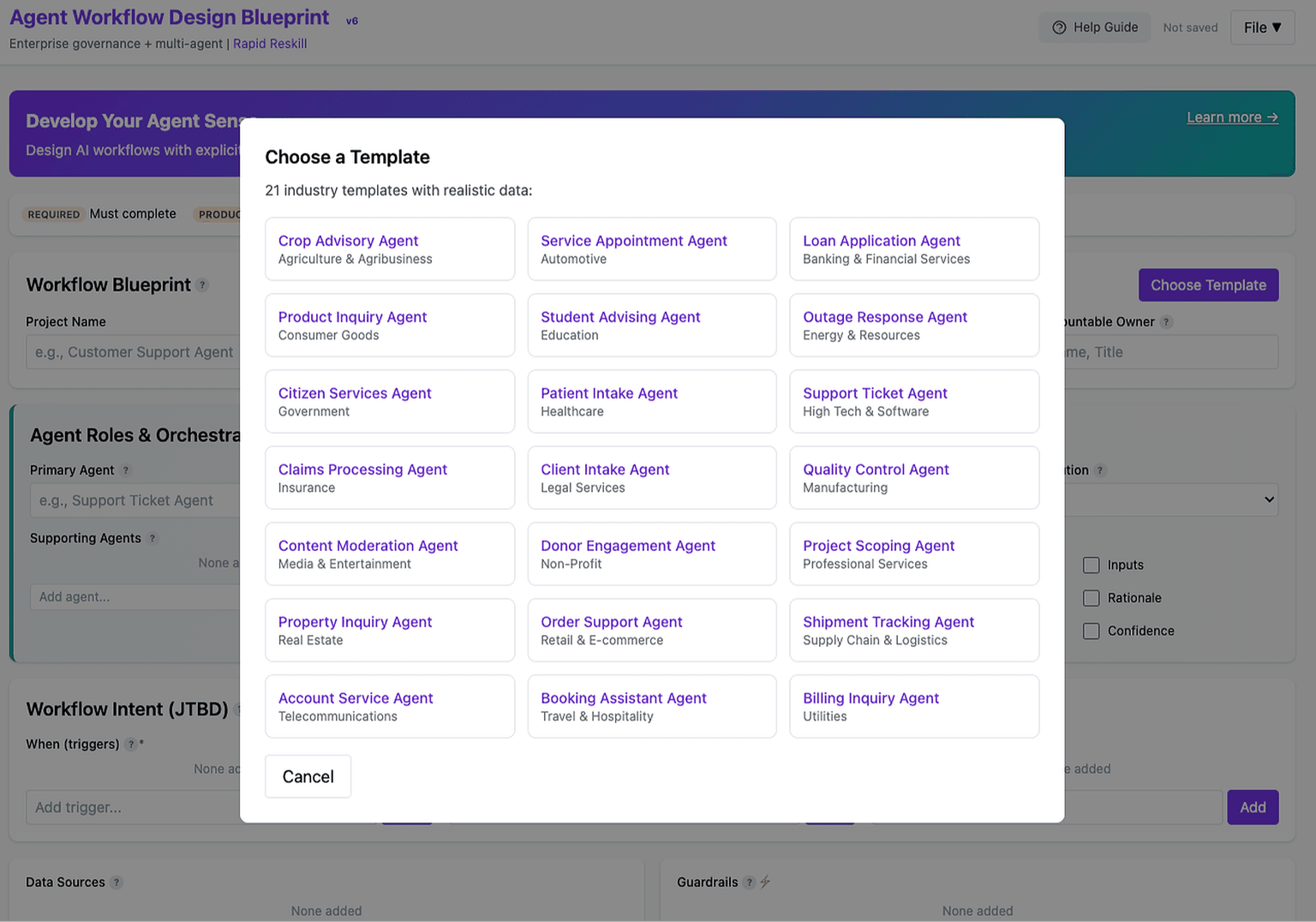
Select a template for your industry or start from scratch. Export stakeholder-ready documentation.